
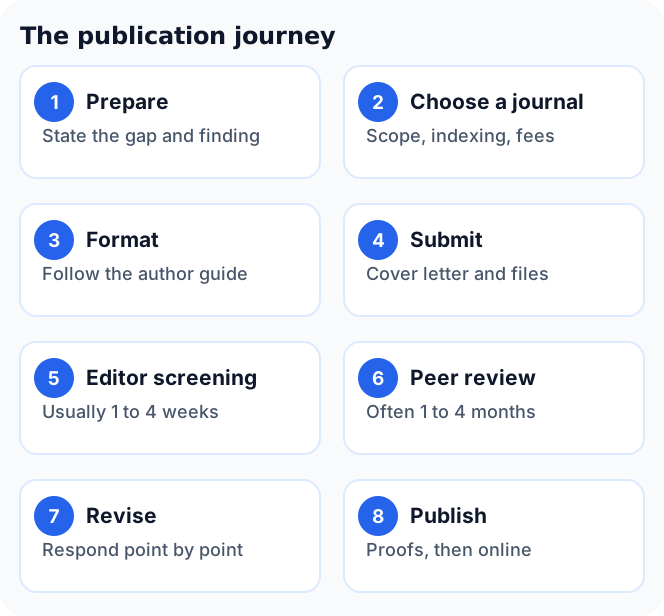
Learning how to publish a research paper comes down to a clear workflow. You pick the right journal, format your draft to its exact guide, upload your files, and reply well to peer reviewers. Strong science gets your paper accepted, but many good studies get rejected early due to simple mistakes in these steps. Here is the full path from draft to print.
Step 1: Make Sure the Paper Is Ready to Publish
Before you browse journals, make sure you can state your contribution in two plain sentences: what gap you tackled and what you found. If that is not clear to you, a busy chief editor will miss it too. Also confirm that all co-authors agree on the author order and that your ethics permit numbers are ready.
Step 2: Choose the Right Journal
Poor journal fit is the number one cause of desk rejection. Build a shortlist of 3 to 5 target journals and check five points for each:
- Scope fit: did the journal publish papers like yours in the past two years?
- Official indexing: check Scopus Sources, the Web of Science Master Journal List, PubMed, or DOAJ directly. Never trust badges on a journal's own home page.
- Limits: check word count, figure count, and reference caps for your article type.
- Cost: check whether it is free subscription publishing or paid open access.
- Review speed: look up the median days to first decision on the journal site.
Watch out for predatory journals: delete spam emails that flatter your past work, promise peer review in 48 hours, or ask for fees before acceptance. Use the free checklist at thinkchecksubmit.org to stay safe.
Aiming for a top-quartile journal? See our Scopus Q1 and Q2 journal publication support to verify SJR and JCR quartiles and screen out cloned websites.
Open Access or Subscription: Which Route?
Peer-reviewed journals use three main cost models. Your choice affects both your budget and who can read your paper:
- Subscription and hybrid journals: libraries pay to read them, so publishing is free for you. You only pay if you choose optional open access.
- Gold open-access journals: free for anyone to read online, but most charge an Article Processing Charge (APC) of $1,000 to $4,000.
- Diamond open-access journals: 100% free for both authors and readers, usually funded by universities or societies.
Check three things before you decide. First, see if your grant requires open access. Second, ask your university library if they have a "read and publish" deal that covers your APC for free. Third, check if you qualify for a publisher fee waiver.
Even if you publish for free in a subscription journal, most publishers let you post your accepted version in an open repository after a short embargo. Check Sherpa Romeo to see your journal's exact policy.
Choosing the Right Article Type
Every journal offers several article tracks, each with strict length and layout rules. Picking the wrong track gets your files sent right back:
- Original research article: a full study with Intro, Methods, Results, and Discussion (usually 4,000 to 8,000 words).
- Short communication or letter: a brief, high-impact result (usually under 2,500 words and 3 figures).
- Review article: a critical synthesis of past studies. Check if reviews are by invitation only before you submit.
- Case report: common in medicine, usually built around the CARE checklist.
- Methods or data paper: presents a new software tool, lab protocol, or public dataset.
Pick your article track first so you follow the right word count and heading rules.
Step 3: Follow the Author Guidelines Exactly
Open the journal's "Guide for Authors" and check every item: heading levels, abstract format, keyword count, citation style (APA, IEEE, Vancouver), figure DPI, and ethics lines. Editors spot recycled formatting from a past rejection in seconds. Converting a degree chapter into a paper? Our thesis editing services help you trim and reformat thesis work for journal submission.
Preparing Your Submission Files
Journal portals ask you to upload several separate files. Getting them right the first time prevents administrative delays:
- Title page: lists the title, all author names, affiliations, ORCID iDs, and the corresponding author's email. Keep it separate for double-blind review.
- Blinded manuscript: strip out author names, grant numbers, and self-identifying lines if the journal uses double-blind review.
- High-res figures and editable tables: upload crisp figures (300+ DPI) and keep tables as editable Word or LaTeX grids, never screenshots.
- Declarations: include ethics permit numbers, funding, conflicts of interest, CRediT author roles, data sharing links, and any AI tool disclosure.
- Supplement files: extra tables, survey tools, or code, labeled clearly.
- Copyright permissions: written permission for any figure reprinted from another paper.
After you upload your files, the portal builds a combined PDF proof. Download that PDF and check every page before you click Approve.
Step 4: Polish the Manuscript
- Title and abstract: these are the first things an editor reads. See our abstract writing guide with examples.
- Introduction: close your intro with a crystal-clear statement of the research gap and your study aim.
- Methods: give enough detail for another lab to repeat your work, and follow CONSORT, PRISMA, or STROBE checklists.
- Results and discussion: report clean data in Results, then explain what they mean, study limits, and next steps in Discussion.
- Language: keep sentences direct and terms uniform. Ask a peer to read your draft or use an expert editor.
Our research paper editing service polishes your English, checks technical terms, and formats your draft to your target journal's house style with tracked changes.
Step 5: Write a Cover Letter and Submit
Write a one-page cover letter that states your main finding, why it matters, and why it fits this journal. Copy our free cover letter for journal submission template. Log in to the submission portal, enter all co-author ORCID iDs, upload your files, and approve the final PDF.
Step 6: Peer Review and Revisions
The chief editor screens your paper first. If it passes, 2 or 3 independent referees review it. Here is what each decision means:
| Decision. | What it means. | Your next move. |
|---|---|---|
| Accept as is. | Very rare on round one. | Celebrate and check page proofs closely. |
| Minor revision. | Small text or figure tweaks needed. | Revise fast and reply point by point. |
| Major revision. | Big changes needed, but the editor wants the paper. | Treat this as a win; address every single point. |
| Reject and resubmit. | Too much work for a normal revision window. | Fix all flaws and upload as a fresh submission. |
| Reject. | Closed at this journal. | Use the referee notes to improve, then try journal #2. |
When you revise, answer every referee comment in a structured table. Our response to reviewers template and examples show you how to write each reply.
If Your Paper Is Rejected
Every active scientist gets papers rejected. What counts is how you handle the next 48 hours:
- Read the letter calmly: a desk rejection means scope fit or framing missed the mark. A post-review rejection gives you free expert feedback.
- Never send the exact same file out again: fix the flaws referees found first. The new journal may invite the exact same referee!
- Consider a transfer link: if the publisher offers to move your paper and reviews to a solid Q2 sister journal, check its indexing first.
- Reformat for the new journal: update the citation style, word count, and cover letter before you upload.
- Only appeal factual errors: appeal only if a referee misread a core data table. Arguing over opinion rarely works.
Step 7: Acceptance, Proofs and Publication
Once accepted, you sign the publishing license, arrange any fee payment, and receive typeset page proofs within 1 to 2 weeks. Check author names, affiliations, math symbols, and table lines within 48 hours. Your paper then goes live online with its permanent DOI.
Mistakes That Delay Publication
Avoid these six traps that add months to your publication timeline:
- Sending your paper to a journal that never publishes your topic or study design.
- Going over the word limit or figure limit so the portal staff return your file.
- Leaving out ethics permit numbers, funding lines, or data sharing statements.
- Having numbers in your abstract that do not match your results tables.
- Sending vague or defensive replies to peer reviewers.
- Skimming page proofs and missing a typo in an author name or equation.
Publishing as a Student or Independent Researcher
Students publish in top journals every day, either with an advisor or on their own. Independent scholars without a university job can publish too. Read our full guide on how to publish a research paper independently.
Frequently Asked Questions
How long does it take to publish a research paper?
First peer-review decisions usually take 6 to 12 weeks. Because most accepted papers go through one or two revision rounds, total time from upload to publication is typically 4 to 9 months.
How much does it cost to publish a research paper?
Many subscription and hybrid journals charge $0 to publish. Full open-access journals charge an APC between $1,000 and $4,000, though university deals and country waivers often cover this cost.
Can a student publish a research paper?
Yes. Master's, PhD, and undergraduate students publish in peer-reviewed journals regularly, either with a faculty advisor or as solo authors.
Can I submit my paper to more than one journal at a time?
No. Every ethical journal forbids submitting the same paper to two journals at once. Submit to one journal, wait for the decision, and move to the next only if rejected.
What is desk rejection?
A desk rejection is when the chief editor rejects a paper within days without sending it to peer reviewers. Common causes are poor scope fit, unclear novelty, or broken formatting rules.