
This guide gives you a response to reviewers example for every common case: agreeing, partly agreeing, and politely pushing back. You also get a point-by-point template you can copy. A clear response letter lets the editor verify in minutes that you handled every comment. That clarity often turns a major revision into an acceptance.
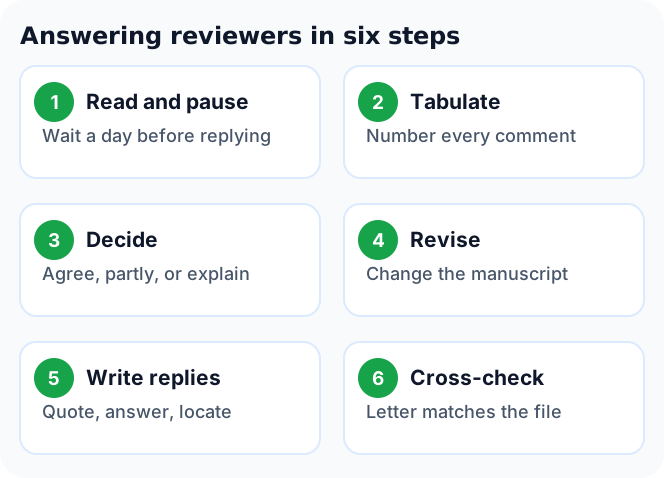
The Five Rules of a Strong Response Letter
- Answer every comment. Include minor notes and points you disagree with.
- Quote the comment in full. Write your reply right below it.
- State what changed and where. Give exact page and line numbers, and paste the new text.
- Stay polite and factual. If a reviewer misread your paper, treat it as a sign that your text needed to be clearer.
- Match the paper to the letter. Editors check both files side by side.
Point-by-Point Response to Reviewers Template
Organising Reviewer Comments Before You Reply
Before you write a single reply, put every comment into a tracking table. This turns a long decision letter into a simple task list. It also stops you from missing a point. Use these five columns:
- ID: Reviewer and comment number, such as R1.4.
- Comment: The full text, copied word for word.
- Type: Major (data, design, logic), minor (clarity, missing detail), or small (typos, style).
- Action: Agree and change, partly agree, or explain without changing.
- Owner and place: Which co-author handles it, and the page and line in the revised file.
Start with the major comments first, since they can shift other parts of your paper. Save small wording fixes for last.
Response to Reviewers Examples
The sample comments and replies below show the right tone and structure.
Example 1: Agreeing and making the change
The sample size calculation is missing. Please justify the number of participants.
Response.Thank you for pointing this out. We added the sample size math to the Methods (page 6, lines 132–138): "Assuming a medium effect size (d = 0.5), alpha = 0.05, and power of 0.80, we needed at least 64 people per group. We enrolled 70 per group to cover drop-outs."
Example 2: Partly agreeing
The authors should repeat the test at three more temperatures.
Response.We agree that a wider range strengthens the findings. During the revision window, we added one more temperature (60 °C). The new results match our main trend (see Figure 4c; page 11, lines 245–252). Testing higher heat requires lab gear we do not have. We now note this limit and suggest it for future work (page 15, lines 340–343).
Example 3: Politely disagreeing
A qualitative design is wrong for this question; the authors should use a survey.
Response.We thank the reviewer for this thought. Our goal was to explore how people made choices. That is a process question best answered through interviews. A survey measures rates but not the reasoning we studied. We made this point clearer in the Methods (page 5, lines 98–106) and noted in the Limitations that our study does not estimate population rates (page 14, lines 318–321).
Example 4: The reviewer misread something
The authors did not control for age.
Response.Thank you for this note. We included age as a control in all models, but we did not state this clearly enough. We now state it directly in the Methods (page 7, line 151) and in the note below Table 2.
Formatting the Response Document
Editors and reviewers read faster when your response letter uses a clean layout:
- Set each reviewer comment in bold or a different color so your reply stands out.
- Use the exact same comment numbers as your tracking sheet (R1.1, R1.2).
- Give page and line numbers from the revised file. Turn on line numbers in Word before you write the final numbers.
- Upload both a clean revised paper and a tracked-changes version, unless the journal asks for only one.
- Save the file in the format the portal requests (Word or PDF) and check that math symbols display properly.
Phrases That Keep the Tone Right
| Instead of this. | Try this. |
|---|---|
| "The reviewer is wrong." | "We did not explain this clearly. We revised the text on page X." |
| "This is out of scope." | "This is an important question. It falls outside our current study, so we added it as future work on page X." |
| "We did this already." | "We report this test in Section X, and we added a pointer on page Y to make it easy to find." |
| "Done." | "We added this detail on page X, lines Y–Z." |
When Reviewers Disagree With Each Other
Sometimes Reviewer 1 asks for more detail while Reviewer 2 asks you to cut text. Do not try to please both in secret. Answer each reviewer in their own section, explain which path you took, and flag the conflict for the editor in your opening paragraph. Editors deal with this every day.
Read the editor's letter carefully too. If the editor highlights specific points, treat those as your top priorities.
Citation Requests and Deadlines
Reviewers often suggest useful papers to cite. However, if a reviewer asks you to cite several papers that do not fit your topic, you can politely decline and explain why. You can also note this to the editor in private.
Journals usually give 30 to 90 days for a revision. If you need extra time to run new tests, ask the editor for an extension early. Most editors grant reasonable requests.
Before You Submit the Revision
- Every reviewer comment has a numbered point-by-point response.
- Every page and line reference matches the final revised manuscript file.
- Both the clean manuscript and the tracked-changes version contain all promised revisions.
- All newly cited studies appear in the bibliography, and new figures are referenced in the text.
- Every co-author has reviewed and approved both the revised manuscript and the response letter.
Our Scopus reviewer response support builds this point-by-point response table with you, our research paper editing service polishes your revised manuscript sections, and our thesis editing services help doctoral candidates address committee revisions.
Frequently Asked Questions
How long should a response to reviewers letter be?
Make it as long as needed to answer every point in full. Many response letters run 5 to 15 pages. Clear quotes and exact line numbers matter more than length.
Should I thank reviewers for every comment?
No. A warm thank-you at the start of the letter is enough. Repeating "thank you" before twenty replies adds clutter.
Can I refuse to make a change a reviewer requested?
Yes, if you give solid data or clear reasons and stay polite. Offer a helpful compromise, such as clarifying the text or adding a study limit. The editor makes the final call.
How do I show changes in the revised manuscript?
Follow the journal's rules. Most journals ask for a tracked-changes file or highlighted text alongside a clean copy. Always list exact page and line numbers in your letter.