
A cover letter for journal submission is your one-page pitch to the chief editor. It states what you found, why it matters, and why it belongs in their journal. It also holds the formal ethics lines that journals require. Editors read it to decide whether to send your paper out for peer review. Clear facts beat hype every time. Below is a copy-ready template, three field examples, and a quick checklist.
What Editors Look for in a Cover Letter
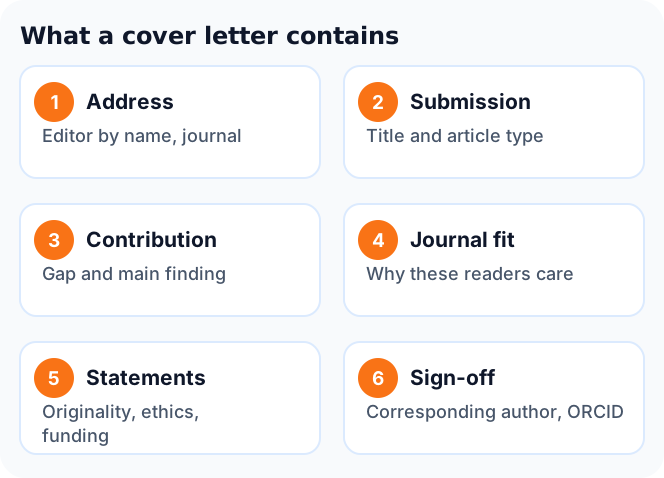
- The basics: paper title, article type, and journal name, addressed to the editor by name.
- The contribution: the research gap and your main result in two or three plain sentences.
- Journal fit: why this journal's readers will care. Link your topic to its scope or recent papers.
- Required statements: originality, co-author sign-off, conflicts of interest, funding, and ethics permit numbers.
- Contact info: the corresponding author's email, ORCID iD, and suggested reviewers if requested.
Tone, Length and Addressing the Editor
Address your letter to the editor who will handle your paper. Check the journal's board page to find the Editor-in-Chief or the right section editor. If you cannot find a name, write "Dear Editor-in-Chief." Never write "To whom it may concern."
Keep your tone calm and factual. Editors read hundreds of claims every month. Words like "groundbreaking" or "first ever" backfire unless your data prove them. A concrete result with a number persuades an editor much faster than buzzwords.
Keep your letter to one page (about 250 to 350 words). If it runs longer, you are likely repeating your abstract or methods. The editor has your manuscript right there. Use the letter to show why the paper deserves peer review.
Cover Letter Template for Journal Submission
Writing the Contribution Paragraph
The middle paragraph is the part editors read most closely. Use this simple four-sentence formula in any field:
- The problem: state what is unknown or unsolved in one short sentence.
- What you did: name your study design or sample size in plain words.
- What you found: state your main result with one key number or effect size.
- Why it matters: explain who can use the finding and what it changes.
Write this paragraph last, after your paper is final, so the claims match your text. Check that your title, abstract, intro close, and cover letter all state the same core advance.
Cover Letter Examples
These three examples show the middle "contribution and fit" section. Use the template above for the opening and closing lines.
Post-op delirium affects up to one in three older surgery patients. Yet few hospitals screen for it daily. In our cohort of 412 patients across three hospitals, a two-minute bedside test caught delirium with 89% sensitivity when run by nurses. Because [Journal] recently published two studies on older surgical care, we believe your clinical readers will find this tool useful right away.
Current fault-detection tools for small wind turbines need costly vibration sensors. We present a method that uses only existing power output logs. Across field data from 18 turbines, it matches sensor accuracy at zero hardware cost. This work fits [Journal]'s focus on low-cost monitoring for clean energy grids.
Most studies on remote work focus on big tech firms. Using interviews with 46 small business owners, we map three ways small teams keep staff connected. We also show how each choice tracks the owner's past career. Given [Journal]'s focus on small business leadership, this study adds fresh data to an active debate.
Cover Letter Checklist
- Check the journal name and editor name (fix any copy-paste leftovers from past submissions).
- Verify that the paper title matches your manuscript file word for word.
- State your main finding in plain English without hype.
- Name one clear reason why your paper fits this specific journal.
- Include originality, co-author approval, conflict, funding, and ethics lines.
- Keep it to one page, proofread it, and save it as a Word or PDF file.
Want a second pair of eyes before you upload? We draft and check cover letters in our Scopus Q1 and Q2 journal publication support. Our research paper editing service also ensures your manuscript reads just as clearly, and our thesis editing services help graduate students turn thesis chapters into journal drafts.
Special Situations to Mention
Always state these five facts in your cover letter, even if the upload portal skips them:
- A posted preprint: If your draft is on arXiv, bioRxiv, medRxiv, or SSRN, name the server and add the DOI link.
- Related papers: If you used the same dataset in another paper, name it and show how this draft adds new work.
- A special issue: Put the exact issue title and guest editor names right in line one.
- A transferred paper: If a sister journal sent your file here, note whether past peer reviews came with it.
- A conference version: If a short note ran at a meeting, list what new data you added (most journals want at least 30% fresh content).
Full honesty protects your team. Hidden overlap is a top trigger for early desk rejection.
Cover Letter for a Resubmission
Resending a draft after a major revision? Put the old paper ID in line one and list your top three fixes. Add a full reply table; see our response to reviewers template. Want expert eyes on your files? Our journal submission and reviewer response support covers cover letters, ethics forms, and layout.
Frequently Asked Questions
How long should a cover letter for a journal be?
Usually one page, around 250 to 400 words. Editors read many letters a day; a concise letter that clearly states the contribution and fit is more effective than a long one.
Is a cover letter required for journal submission?
Most journals ask for one, and some systems have a text box instead of an upload. Even when optional, a short letter helps the editor understand your paper quickly.
Should I suggest reviewers in my cover letter?
Only if the journal asks for suggestions, which is often done in the submission system instead. Suggest independent experts without conflicts of interest, such as recent co-authors or colleagues at your institution.
What should I not include in a cover letter?
Don't copy the abstract word for word, overstate your findings, criticize other journals or researchers, or include confidential information about previous rejections unless the journal asks.