
Can you publish a research paper independently? Yes, you can. Journals judge the quality of your study, not where you work. Every month, journals publish papers by solo authors, retired faculty, doctors in private clinics, tech workers, and recent grads. You will face a few hurdles around workplace lines, ethics sign-off, fees, and library access. This guide shows you how to solve each one.
What Journals Actually Require
Good journals care that your work is new, sound, honest, and clear. Standard author rules never require a school job. Many journals also use double-blind review, so referees never see your name or workplace.
Here is what you do need to submit:
- A workplace line: "Independent Researcher, City, Country" is accepted by almost every journal.
- An ORCID iD: Sign up for free at orcid.org. Most portals ask for it.
- A clean email address: A personal email works fine if it uses your real name.
- Ethics sign-off: Needed only if your study tests people, private records, or animals.
The Main Challenges, and Solutions
| Challenge. | Solution. |
|---|---|
| Ethics sign-off without a school. | Use an independent ethics board (IRB), partner with a co-author at a school, or analyze public anonymous datasets. |
| High publication fees (APCs). | Pick hybrid subscription journals (free to publish) or diamond open-access titles. Ask for fee waivers early. |
| Reading paywalled papers. | Use Google Scholar, Unpaywall, public libraries, alumni access, or email authors directly for a PDF copy. |
| No advisor feedback. | Ask a peer to read your draft, share a preprint, or use our research paper editing service before upload. |
| Fake journals targeting solo authors. | Check official index lists yourself and ignore spam emails. See our Scopus Q1 and Q2 publication support. |
Fees and Funding for Independent Authors
When you publish on your own, you have no grant fund to pay journal fees. Plan your budget before you pick a journal.
- Subscription and hybrid journals: Most charge zero fees when you choose the standard print path. Readers use library access to read the article.
- Diamond open-access journals: These journals are free for both authors and readers. Filter for zero-fee journals on the DOAJ site.
- Fee waivers: Many large publishers cut or waive fees for unfunded solo authors. Always ask for a fee waiver before you submit.
- Watch for paid traps: Any journal that demands cash before peer review or promises two-day accept notes is a scam.
Ethics Approval Without an Institution
Any study that tests people, checks private health files, or uses animals needs ethics board sign-off before data work starts. Journals ask for the board name and permit code. They reject drafts that skip this step.
Solo authors have three clear paths. First, some hospitals and colleges check outside studies for a small review fee. Second, private ethics boards (IRBs) review independent work. Third, you can add a college co-author so the study sits under their school board.
Many studies need no ethics sign-off at all. Common cases include literature reviews, math or theory work, and public data sets like World Bank files. Even then, write one clear line in your methods part to note why your study is exempt.
Preprints and Repositories
Posting a preprint makes your paper public and citable right away while you wait for peer review. Popular free archives include arXiv (physics, math, computer science), bioRxiv and medRxiv (biology and medicine), SSRN (social sciences), OSF Preprints, and Zenodo (all fields). Check your target journal rules first—most major journals welcome preprints.
Can You Publish on Google Scholar?
Google Scholar is a search engine, not a journal. You cannot upload a file directly to Google Scholar. Instead, publish your paper in an indexed journal or upload a preprint to Zenodo, SSRN, or OSF. Google Scholar crawls those sites automatically and adds your paper within a few weeks. Once it appears, you can open a free Google Scholar author profile.
Building Credibility Without an Affiliation
Referees judge your data, but a tidy author footprint helps chief editors trust your work. Here is how to build one fast:
- Fill out your free ORCID profile with your degree history and past papers.
- Upload your raw data and code to Zenodo or OSF so they get a permanent DOI link.
- Present early findings at a workshop or society meeting to get feedback.
- Partner with an academic co-author when a project needs lab gear or school ethics review.
- State your funding and conflict-of-interest lines plainly, even when both are "none."
Many solo scholars start with society journals or specialized Q2 titles that welcome applied research. Turning an old master's or doctoral study into a paper? Our thesis editing services help you trim and reframe degree chapters for journal readers.
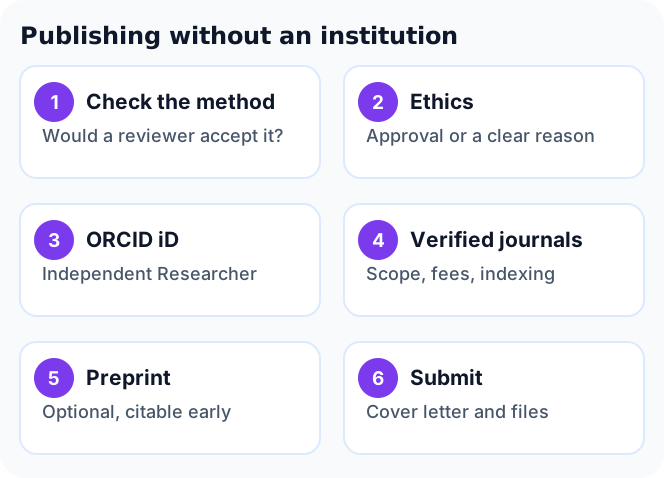
Step-by-Step for Independent Authors
- Check that your study question and methods meet current standards in your field.
- Secure ethics sign-off or write a clear note explaining why your public dataset is exempt.
- Register an ORCID iD and set your affiliation line to "Independent Researcher, City, Country."
- Shortlist 3 to 5 real journals that match your topic and charge zero fees.
- Format your draft to the journal guide and write a clear one-page cover letter.
- Post an optional preprint, then upload your files to the journal portal.
For the full submission walkthrough, read our guide on how to publish a research paper.
When you work without a lab team behind you, an outside check pays off. Our verified Q1 and Q2 journal shortlist service keeps you safe from fake journals, and our research paper editing service polishes your prose before an editor reads page one.
Frequently Asked Questions
Can I publish my own research paper on Google Scholar?
Not directly. Google Scholar is a search engine, not a publisher. It indexes papers from journals and public archives. To show up there, publish in a journal or upload your paper to Zenodo, SSRN, OSF Preprints, or arXiv.
What do I put as my affiliation if I'm not at a university?
Write "Independent Researcher, City, Country." Almost every journal accepts this format. If you work at a company or clinic tied to the study, you can list that workplace if your boss agrees.
Do journals reject papers from independent researchers?
Good journals judge the paper, not your job title. Many use double-blind review where referees never see author names. Still, solo papers get close checks on methods and ethics, so report both clearly.
Where can I publish my research paper for free?
Most subscription journals charge zero fees to publish under the standard track. Diamond open-access journals are also free for both authors and readers. Use the DOAJ directory to filter for zero-fee journals.